Oklahoma Coverage D: Loss of Use
How Oklahoma Home Insurance Pays for Housing, Meals, and Living Costs After a Covered Loss
Coverage D (Loss of Use) serves as the financial bridge between the moment a covered catastrophe forces you out of your home and the moment you are legally permitted to return. When severe convective storms, straight‑line winds, fires, or catastrophic tornadoes compromise your property, this coverage keeps your household functioning while your structure is being repaired or rebuilt.
Coverage D does not replace your baseline cost of living; it pays only for the increase in expenses caused by the loss. Because it is governed by strict contractual caps and state‑level conditions, understanding the activation triggers and mathematical failure points is critical to avoiding financial exhaustion mid‑rebuild.
Coverage D: What’s Included vs. What’s Not
Coverage D applies only when a covered peril renders the home legally or functionally uninhabitable. It reimburses the net variance between your pre‑loss baseline costs and your post‑loss emergency costs.
Included (Increases Only)
Temporary housing, increased food costs, emergency laundry, storage fees, pet boarding, increased transportation, and temporary utilities.
Excluded (Baseline / Out‑of‑Scope)
Mortgage payments, normal grocery budgets, normal utilities, luxury housing upgrades, excluded‑peril displacement, voluntary relocation, and loss of income.
Contractual Boundary Rule
Coverage D never functions as a lifestyle upgrade. Adjusters benchmark local rental markets to ensure temporary housing matches the square footage, utility scope, and grade of your damaged dwelling.
Once you understand what qualifies as an eligible increase—and what gets denied—the next question becomes how the policy actually delivers those dollars. That’s where the two internal engines of Coverage D take over: one protects your household’s survival costs, and the other protects your rental income stream. Together, they determine how fast your limit burns and how long your displacement remains financially survivable.
“Loss of Use isn’t one bucket of money—it’s two engines running off the same fuel. If you don’t know which one is pulling harder, you won’t know when the tank runs dry.” — Micah Belyeu
The Two Legal Engines Inside Coverage D
Additional Living Expenses (ALE) ALE protects your household from the spike in survival costs while displaced—housing, food logistics, transportation shifts, and other increases required to maintain your baseline standard of living.
Fair Rental Value (FRV) FRV protects your passive income stream when a tenant‑occupied portion of your property becomes uninhabitable due to a covered loss.
Shared‑Limit Failure Point
If you operate an owner‑occupied multi‑family dwelling, a severe storm triggers both ALE (your family) and FRV (your tenant). Both draw from the same Coverage D limit, causing funds to burn out twice as fast.
When Coverage D Activates: The Uninhabitable Standard
Uninhabitable is the gatekeeper of Loss of Use benefits. A property is not uninhabitable because construction is loud or a room is out of service. It must be legally condemned or functionally unsafe.
Verified Uninhabitable Triggers Structural failure, loss of essential utilities, HVAC failure during extreme Oklahoma heat, smoke infiltration, mold contamination, or gas leaks.
Civil Authority Triggers Coverage D can activate even without property damage if civil authorities bar access due to damage to neighboring structures caused by a covered peril.
The 14‑Day Prohibited Access Rule If access is officially restricted due to damage from a covered peril, ALE benefits activate for up to 14 consecutive days.
Peril Restriction Evacuations caused by rising water or flooding do not trigger Coverage D unless you maintain a separate flood policy.
How Coverage D Behaves in Oklahoma
Oklahoma’s convective weather patterns compress Coverage D limits faster than the national average.
Simultaneous Mass Displacement Large‑scale storms displace hundreds of families at once, collapsing the short‑term rental and hotel market.
Contractor Backlogs and Rebuild Stretch Regional labor shortages stretch rebuilds from 6 months to 18–24 months.
Rural Inventory Scarcity Outside OKC and Tulsa, comparable rentals may not exist, forcing long‑distance displacement and increased transportation costs.
The Four Clocks of Loss of Use
Coverage D ends at the earliest:
Time to Repair
The time reasonably required to repair the structure.
Time to Replace
The time required to fully replace the home.
Time to Permanently Relocate
If you choose not to rebuild, Coverage D ends when relocation is complete.
Exhaustion of the Coverage D Limit
Coverage D stops the moment the financial limit hits zero.
The Four Clocks show when Coverage D stops. The next question is how fast your limit burns under real Oklahoma displacement conditions.
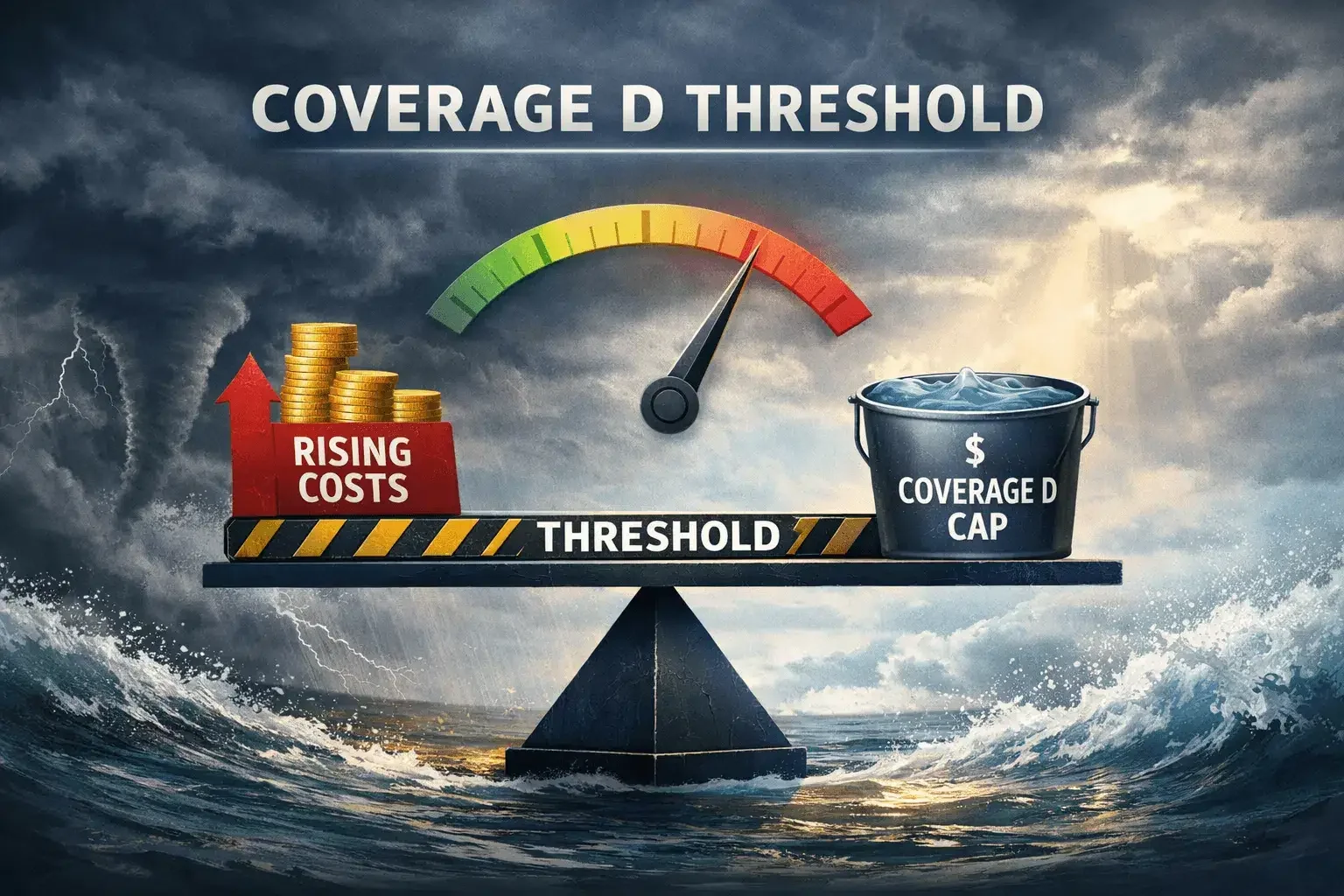
That requires knowing your actual Coverage D limit — not the number you hope you have, but the number your contract actually provides. Before you can measure burnout, gaps, or exposure, you must quantify the percentage your policy assigns to Loss of Use. That percentage determines how long your household can survive under forced displacement.
“You can’t manage the burnout until you know the bucket. Coverage D isn’t emotional — it’s math, and the math decides how long you can stay afloat.” — Micah Belyeu
Coverage D Tier Calculator
Coverage D Limit: —
Implied % of Coverage A: —
Math Check: —
The Tornado Displacement Failure Scenario
Most Oklahoma homeowners exhaust Coverage D before the rebuild is complete.
Mathematical Breakdown Coverage A = $300,000 Coverage D (20%) = $60,000 Monthly increases = $4,000 Coverage D duration = 15 months Typical rebuild = 18–24 months
Tornado Displacement Failure Simulator
Coverage D Limit: —
Months Funded: —
Rebuild Duration: —
Unfunded Gap: —
Out-of-Pocket Exposure: —
Math Check: —
“The dangerous structural flaw in modern Oklahoma home insurance isn’t the dwelling coverage—it’s the ticking clock on Coverage D… Homeowners aren’t running out of hope; they are running out of contract.” — Micah Belyeu
Oklahoma Post‑Tornado ALE Burnout Calculator
Projects the month Coverage D (Loss of Use) runs out based on Coverage A, Coverage D tier, Oklahoma county, and monthly increases.
Coverage D Limit: —
Months Until Coverage D Burnout: —
Burnout Month Index: —
County Context: —
Math Check: —
This calculator is educational only and does not change, extend, or interpret any insurance contract.
Market Pressures: The Post‑Storm Hotel Surge
Hotel surge pricing increases 30–60% after major storms, rapidly accelerating Coverage D burnout.
Surge Math Normal rate: $110/night Surge rate: $159.50/night Monthly burn: $4,785 (hotel only) Total burn with food + misc: $5,985/month Coverage D exhaustion: ~10 months
Hotel Surge vs Standard ALE Burn Rate
Proportional comparison of standard ALE burn rate, surge‑pricing burn rate, and the dollar difference between them.
What Counts as “Unlivable”?
1. Unsafe Temperatures
If the home can’t stay at a safe temperature — especially during Oklahoma heat or freezes — the home fails basic habitability.
2. No Safe Utilities
Boil‑water notices, power outages, or sewer warnings mean the home is not livable, even if the structure is still standing.
3. Daily Life Isn’t Possible
If you can’t cook, bathe, sleep safely, store food, or keep medications at the right temperature, the home is not functional — ALE applies.
4. Safety Hazards
Exposed wiring, broken windows, structural cracks, mold, or debris that blocks rooms make the home unsafe to stay in.
The Habitability Battleground: What To Do When an Adjuster Pushes Back
Keep a Simple Temperature Log
Write down the temperature inside your home and take a photo of the thermometer. Do it every few hours. This proves the home is too hot or too cold to live in safely.
Save All City or Utility Alerts
Screenshots of boil‑water notices, power‑outage alerts, or sewer issues show that the home is not livable, even if the structure is still standing.
Use the Appraisal Clause When Needed
If the adjuster won’t agree on what’s fair, the policy lets you bring in an independent expert to settle the value. This stops the argument and forces a neutral decision.
Real‑World Oklahoma Coverage D Scenarios
Coverage D Limit: —
Monthly Expenses: —
Months Covered: —
Outcome: —
Burden of Proof: Your Documentation Checklist
Coverage D is audit‑driven. If an expense cannot be documented, it will be denied.
Required Documentation Itemized dining receipts Hotel folios Lease agreements Utility comparisons Mileage logs
Pro‑Tip Use ALE Solutions or CRS to avoid floating thousands on personal credit cards.
Mobile ALE Expense Log & Document Vault
Log Additional Living Expenses, track remaining Coverage D, and generate adjuster‑ready summaries. Session‑only; data clears when the page reloads.
Total Logged Expenses: $0
Remaining Coverage D: $0
Status: —
Average Daily Burn Rate: —
Projected Days Until Exhaustion: —
| Date | Category | Amount | Note | Receipt | Preview | Actions |
|---|
Explore Home Insurance Topics
These national guides explain how home insurance works across the United States. They remain active until state‑specific pages are built.
Need Help Understanding Your Policy?
If you want help reviewing your home insurance coverage or understanding how your deductible, roof coverage, or exclusions work, you can request a policy review. This is an informational service and does not obligate you to make any changes.
Request a Policy ReviewCoverage D: Loss of Use — Frequently Asked Questions
What does Coverage D actually pay for?
Coverage D pays for the increase in your living expenses after a covered loss. It does not replace your normal cost of living. It covers the extra cost of housing, meals, transportation, and daily life while your home is being repaired or rebuilt.
When does Coverage D activate?
Coverage D activates when your home becomes uninhabitable due to a covered peril. This includes structural failure, loss of essential utilities, extreme heat from HVAC destruction, smoke or gas hazards, or civil authority blocking access.
Does my home have to be destroyed for Coverage D to apply?
No. A home can be standing but still legally uninhabitable. If you cannot safely live inside due to heat, contamination, utilities, or safety hazards, Coverage D applies.
What’s the difference between ALE and Fair Rental Value?
ALE (Additional Living Expenses) pays for your increased living costs when you must live elsewhere. Fair Rental Value pays for lost rental income if a tenant must move out due to a covered loss. Both draw from the same Coverage D limit.
How long does Coverage D last?
Coverage D lasts until your home is livable again or until the Coverage D limit is exhausted. There is no fixed timeline — it is purely math: Coverage D Limit ÷ Monthly Increase = Months of Coverage.
Does Coverage D cover hotel surge pricing?
Yes. If storms wipe out local housing supply and hotel rates spike, the increased cost is part of ALE because it is directly caused by the covered loss.
Are meals covered under Coverage D?
Yes, but only the extra cost above your normal food spending. Coverage D pays the difference between your normal food cost and your displaced food cost.
Does Coverage D cover rent for a temporary home?
Yes. Rent, deposits, pet fees, and temporary housing costs are covered if they are part of the increased cost of living caused by the loss.
Does Coverage D cover mortgage payments?
No. Your mortgage is a baseline cost of living and does not change because of the loss. Coverage D only pays for increases.
Does Coverage D cover flood evacuation?
Not under a homeowners policy. Flood evacuation is only covered if you have a separate flood insurance policy.
Does Coverage D cover civil authority evacuations?
Yes, up to 14 days, if the evacuation is due to damage from a covered peril near your home.
What happens if my rebuild takes longer than my Coverage D limit?
Once the Coverage D limit is exhausted, all remaining living expenses become out‑of‑pocket. This is common after tornadoes with long rebuild timelines.
What if the adjuster says my home is livable but it isn’t?
You can challenge the determination using temperature logs, utility outage notices, safety hazard documentation, and city or county advisories. If needed, you can invoke the Appraisal Clause for an independent valuation.
Does Coverage D apply if only part of my home is damaged?
Yes. If the damage makes the home unsafe or nonfunctional, Coverage D can activate even if the structure is partially intact.
Can Coverage D run out before my home is repaired?
Yes. If your ALE burn rate is high (hotel surge pricing, long rebuilds, supply chain delays), you can exhaust Coverage D months before your home is ready.
Why is Coverage D tied to Coverage A?
Most Oklahoma policies set Coverage D as a percentage of Coverage A (often 20% or 30%). For example: $300,000 × 20% = $60,000 Coverage D.
What expenses are never covered under Coverage D?
Coverage D never covers mortgage payments, normal food costs, normal utilities, upgrades, improvements, or losses unrelated to displacement. It only pays for increases caused by the covered loss.
Hello, World!
Coverage D, also called Loss of Use, is the part of an Oklahoma home insurance policy that pays the increase in your living costs when a covered catastrophe makes your home legally or functionally uninhabitable. It funds the gap between your normal budget and emergency housing, food, transportation, and utility expenses so your household can keep functioning while the structure is being repaired or rebuilt.
Because Oklahoma tornadoes and severe convective storms can stretch rebuilds to 18–24 months and drive hotel and rental prices sharply higher, many homeowners exhaust Coverage D months before they can return home. The calculators on this page turn Coverage A, Coverage D tiers, county conditions, and monthly increases into hard numbers so you can see when your Loss of Use limit will burn out and how large the unfunded gap could be if a major storm forces you out of your home.

Disclaimer: This page is for educational purposes only and does not determine legal liability, coverage outcomes, claim results, or carrier pricing. Insurance policies are governed solely by the written contract issued by the carrier. All coverage decisions, underwriting actions, premium calculations, and claim determinations are made exclusively by licensed insurance carriers using their own proprietary models and state‑approved guidelines. Policy terms, exclusions, deductibles, conditions, and interpretations vary by carrier, state, and individual risk profile. Nothing on this page modifies, replaces, or supersedes any insurance contract or legally binding document. For specific guidance, refer to your active policy or consult a licensed insurance professional.
© Storms Anchor Insurance. All rights reserved.
Privacy Policy |
Terms of Use |
Licensing & Disclosures