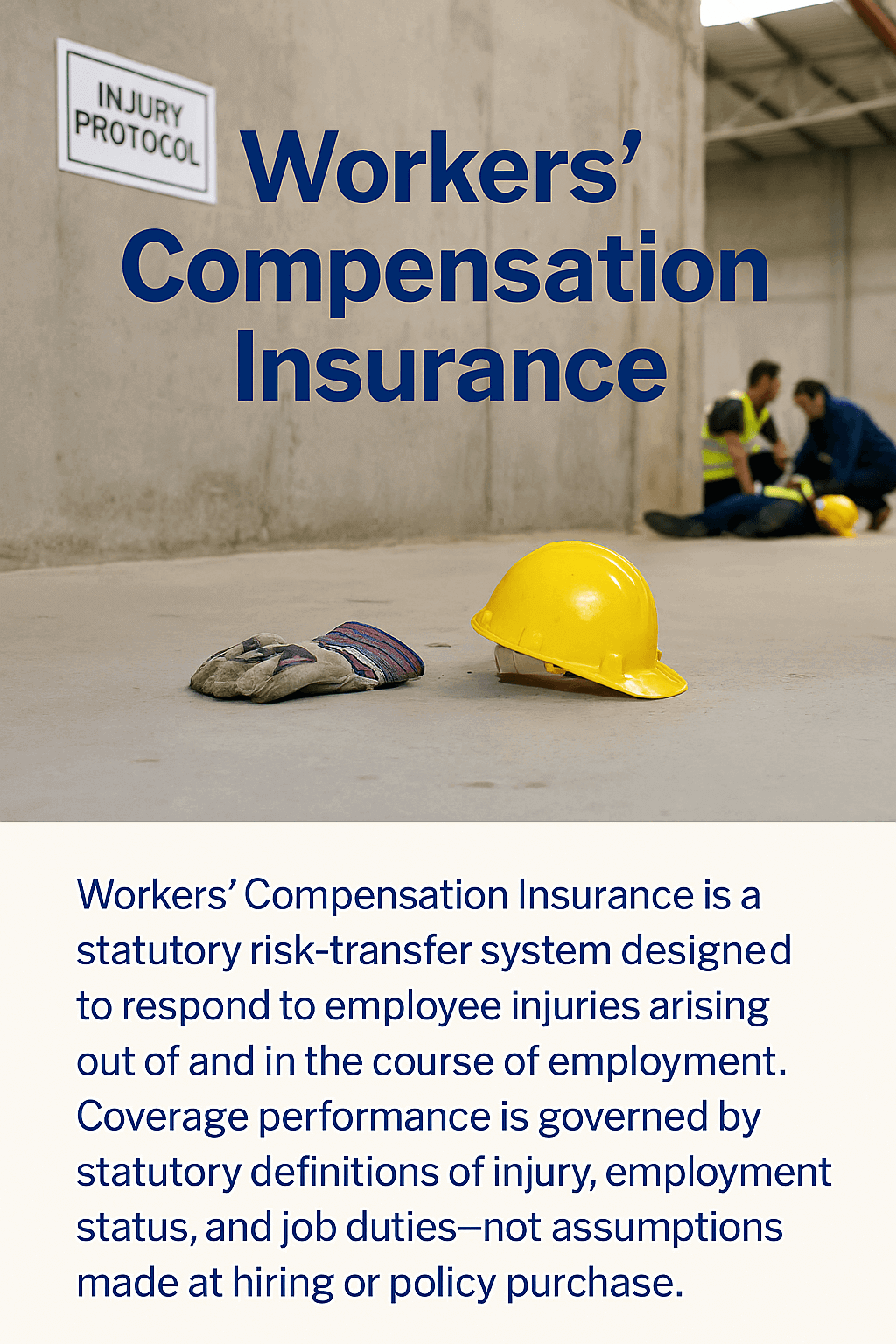
Workers’ Compensation Insurance
Workers’ Compensation Insurance is a statutory risk‑transfer system designed to respond to employee injuries arising out of and in the course of employment. Coverage performance is governed by statutory definitions of injury, employment status, and job duties — not assumptions made at hiring or policy purchase.
Workers’ Compensation does not function like general liability or health insurance. It operates within a state‑mandated framework that governs eligibility, benefits, dispute resolution, and employer obligations.
What Workers’ Compensation Is Designed to Do
Workers’ Compensation Insurance is designed to transfer defined workplace injury risk from employers to an insurance carrier under state law. Its purpose is not to eliminate workplace risk, but to establish a structured system for medical care, wage replacement, and legal protection when covered injuries occur.
A Workers’ Compensation policy is designed to:
Provide medical treatment for covered work‑related injuries and occupational illnesses
Replace a portion of lost wages during periods of disability
Limit employer liability by establishing an exclusive remedy framework
Satisfy statutory insurance requirements imposed by state law
Claim Lifecycle Boundary
Workers’ Compensation responds only within the boundaries defined by statute, policy form, and employment classification. Coverage does not expand based on intent, goodwill, or informal work arrangements. Claim outcomes are determined by how the injury aligns with statutory definitions at the time of occurrence.
How Workers’ Compensation Coverage Responds During Claims
Workers’ Compensation coverage responds based on statutory definitions of employment status, job duties, and injury circumstances — not job titles, payroll assumptions, or internal classifications.
Employee Status Coverage applies only to individuals legally classified as employees. Misclassification disputes frequently determine whether coverage applies at all.
Course and Scope of Employment Injuries must arise out of and occur during employment activities. Deviations, personal errands, or unauthorized tasks can interrupt coverage.
Medical and Disability Benefits Benefits are governed by statutory schedules, treatment guidelines, and impairment ratings — not employer preference or employee expectation.
Exclusive Remedy Protection Coverage limits employee lawsuits against employers when injuries fall within Workers’ Compensation statutes. When coverage fails, liability exposure can reopen.
What a Workers’ Compensation Policy Does — and Does Not — Control
A Workers’ Compensation policy governs how covered workplace injuries are evaluated and compensated. It does not control how injuries occur, how employees behave, or how job duties evolve over time.
Why Workers’ Compensation Claims Fail or Are Disputed
Workers’ Compensation claims are most often denied, delayed, or disputed when employment assumptions do not align with statutory definitions and claim conditions.
Common structural failure points include:
Worker misclassification as independent contractors or exempt employees
Injuries occurring outside the course and scope of employment
Undisclosed or misclassified job duties affecting eligibility
Late injury reporting that complicates causation
Policy lapses or incorrect payroll reporting impacting coverage validity
Workers’ Compensation does not fail randomly. Coverage stops where statutory definitions, employment status, and injury circumstances no longer align. Storms Anchor Insurance evaluates workers’ compensation coverage by analyzing how employment status, job duties, and injury circumstances align with state law rather than assumptions made at policy issuance.
Workers’ Compensation Claim Determination Framework
| Claim Determination Factor | Governing Standard | Why Claims Fail or Are Disputed |
|---|---|---|
| Worker Classification | Statutory definition of employee status | Independent contractor or exempt classification invalidates eligibility for Workers’ Compensation benefits. |
| Course and Scope of Employment | Injury must arise out of and occur during employment | Personal errands, deviations, or unauthorized activities interrupt statutory coverage. |
| Job Duties and Classification | Reported duties must align with actual work performed | Undisclosed or misclassified duties affect eligibility, benefit levels, and carrier response. |
| Injury Causation | Medical evidence must link injury to work activity | Delayed reporting or conflicting medical opinions weaken causation and delay benefits. |
| Benefit Eligibility | Statutory schedules and impairment ratings | Expectations exceed statutory limits for treatment duration or wage replacement. |
| Policy and Payroll Compliance | Active policy with accurate payroll reporting | Lapses, underreporting, or audit discrepancies invalidate or restrict coverage. |
Workers’ Compensation Coverage Interaction Framework
Workers’ Compensation operates alongside — but separately from — other business insurance policies. When injuries trigger multiple exposures, coverage coordination becomes critical.
Workers’ Compensation responds to employee injury benefits
General Liability may respond if third‑party injury or dual‑capacity claims arise
Employment Practices Liability may respond to retaliation or termination disputes
Health insurance may become involved when injuries fall outside statutory coverage
Understanding these boundaries is essential to preventing coverage gaps and unintended liability exposure when workplace injuries trigger multiple policies.
Coverage Decisions and Long‑Term Risk
Workers’ Compensation decisions shape financial and legal outcomes long after a policy is issued. Compliance alone does not guarantee protection. Coverage performance depends on accurate classification, payroll reporting, and alignment between job duties and statutory definitions.
Evaluating Workers’ Compensation Insurance requires understanding how coverage behaves during real claims — not how it appears at purchase.